Chess for Beginner Kids: Why Practice Beats Explanations
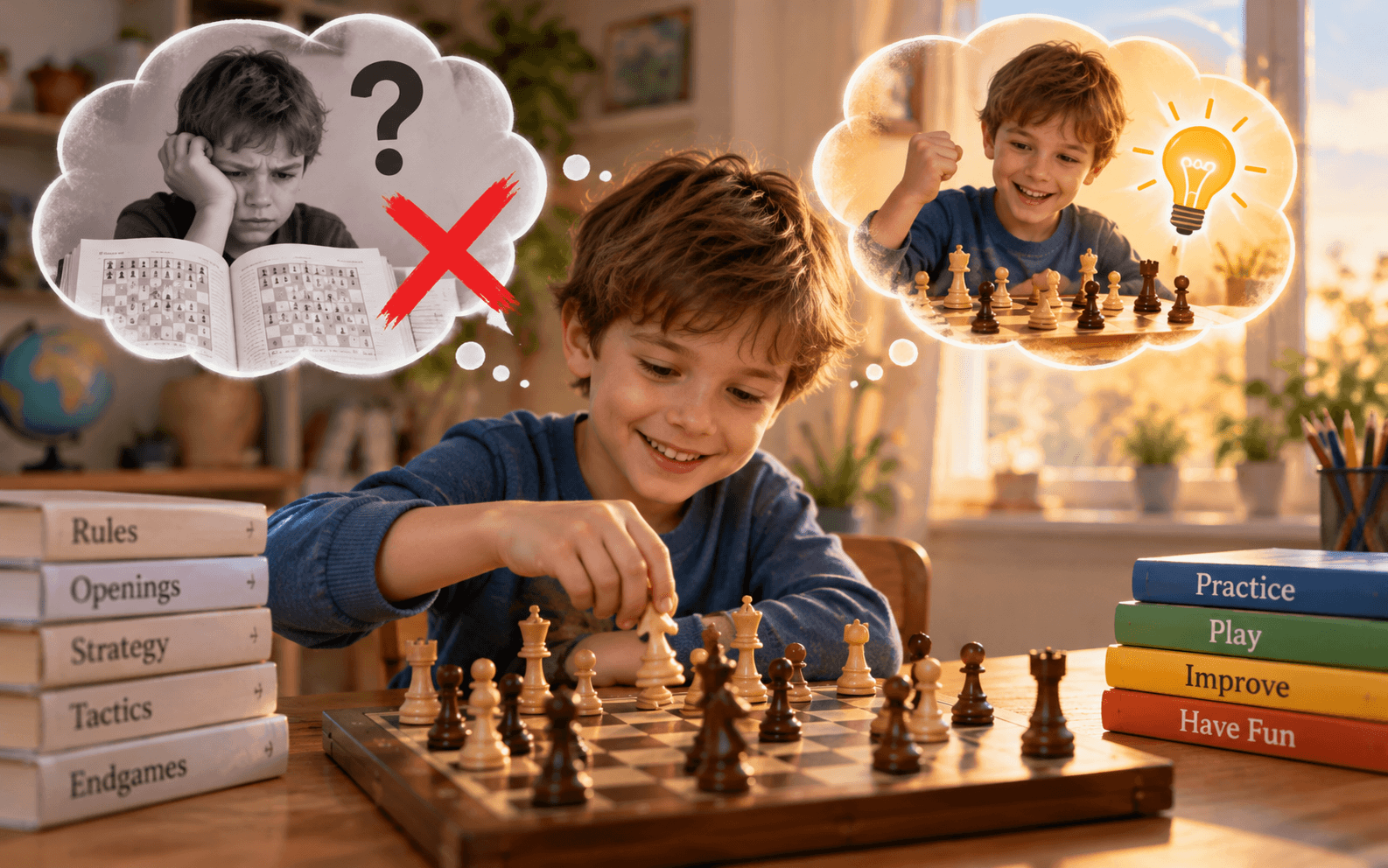
A parent who decides to teach their child chess from scratch immediately runs into the question: how? Buy a book? Sign up for a class? Watch video lessons? All of these share one hidden problem: the child mostly listens and watches instead of doing. And it’s doing that decides whether the knowledge sticks.
The key principle: solving problems matters more than explanations
There’s a common misconception that to learn something, you need to listen carefully and memorize. In reality, passive learning creates an illusion of understanding: it feels like you’ve got it, and a week later almost nothing is left.
A classic experiment by psychologists at Washington University in St. Louis demonstrated this. One group of college students reread a text several times; another read it once and then practiced recalling it from memory. Right after the session, the rereaders seemed to do better. But a week later the picture flipped: they remembered only 40% of the material, while those who had practiced recalling it remembered 61%. That’s about one and a half times as much.
The lesson for chess is direct: a child doesn’t learn how the knight moves by listening to an explanation, but by making fifty knight moves in exercises themselves. Source: Roediger, H. L., & Karpicke, J. D. (2006). Test-enhanced learning: Taking memory tests improves long-term retention. Psychological Science, 17(3), 249–255.
Why kids give up on chess
Even kids who start out excited often lose interest quickly. The reasons are almost always the same:
- A boring start. Long explanations of the rules with no play: the child loses interest before the first game.
- Too much, too soon. When everything comes at once, the child can’t keep up and gives up.
- No visible progress. The child doesn’t feel they’re getting better, and motivation fades.
- Constant losses. Losing to an adult every time kills the desire to play.
The good news: all of this is solved by how the learning is designed. Short steps instead of lectures, visible progress after every block, exercises a child can manage, and the child doesn’t quit. That’s exactly what the course is built on.
What chess lessons really look like
Let’s take an honest look at three ways to learn from scratch: how much independent practice the child gets in each, how much time it takes and how much it costs.
Group class
A coach and 6–10 kids, 45-minute lessons. A good part of the time goes to explaining theory to the whole group. Little time is left for each child to practice independently, and it happens at the group’s pace. Whoever doesn’t get it the first time falls behind: the coach can’t stop the whole group for one child. That’s not the class’s fault; it’s the nature of the group format.
Private lessons with a tutor
Maximum attention: the tutor adapts to the child. But the price is maximal too: $40–100 an hour, according to the Chicago Chess Center. Learning the basics from scratch takes 30–60 lessons, which comes to $1,200–6,000.
Interactive course
Here the child is active every second: learning is built on exercises, not lectures. A short explanation, then an exercise right away. Your child sets the pace: didn’t get it, solve it again. The Chess from Scratch course gives 915 exercises for about the price of a single lesson with a tutor.
Comparing the formats:
| Format | Independent practice | Pace | Cost of the basics from scratch |
| Group class | Little | The group’s | $600–2,400 |
| Private tutor | Maximum | Your child’s own | $1,200–6,000 |
| Interactive course | Constant | Your child’s own | $44.50 |
The main difference between the formats isn’t only the cost but also the amount of independent work the child gets.
Prices vary by city and coach, so check with a specific school or tutor. A detailed breakdown of the formats is in the article How to Choose an Online Chess School.
How learning from scratch should work
The Chess from Scratch course is built on doing. The method runs in a cycle: “Understand. Solve. Reinforce.”
- Understand. A short voiced explanation, usually 15–30 seconds. Not a lecture, just enough to grasp the idea.
- Solve. An exercise right away. The child makes the move, and the system checks it. If it’s wrong, there’s a hint and a chance to fix it.
- Reinforce. A block of exercises on the same topic. After the block, an animated achievement.
The cycle repeats throughout the stage. Instead of listening for 40 minutes, the child acts, and that’s what makes the knowledge stick, as the experiment above showed.
In what order to learn: 12 steps from scratch
The course goes from simple to complex. Each topic is a separate stage with its own exercises:
Board → pieces → rook → bishop → queen → knight → pawn → king → check → checkmate → castling → how a game ends
By the end, your child knows all the rules and can play a game. The first two stages are free, and the full program is here.
What your child can do after the course
By the end of the course, your child:
- knows all the rules and moves every piece with confidence
- understands what check and checkmate are
- can castle
- knows the value of the pieces and can trade them to their advantage
- solves simple combinations and checkmate puzzles
- can play a full game from start to finish
Why it’s better to arrive at a chess class prepared
A child who already knows the letters has an easier time learning to read at school. Chess works the same way. A child who comes to a class already knowing how the pieces move and understanding check and checkmate has a big advantage:
- doesn’t get lost when the coach explains things at the group’s pace
- joins the games right away instead of catching up with the group
- feels more confident, knowing the basics instead of starting from zero in front of everyone
- gets a coach who works on their game, not on how the knight moves
That’s why this combination works best: first the basics at home with an interactive course, then a class for game practice and tournaments. It’s both cheaper and more effective than starting a class from absolute zero.
What keeps a child going: characters and achievements
Any learning only works if the child gets to the end. As we saw above, the main reasons to quit are boredom and invisible progress. In the course, two things keep kids interested:
- 12 characters from legends around the world. Each stage unlocks a new hero from Greek, Norse, Irish and other legends. Kids want to find out who comes next.
- 87 achievements. After every block of exercises comes an animated reward. Progress is visible, and that motivates kids to keep solving.
From the outside it looks like a game, but in fact it’s a structured course with hundreds of exercises. Learning wrapped in a game is exactly what kids this age need.
Conclusion
Teaching a child chess from scratch means letting them act, not making them listen. The science of learning is clear: actively solving problems makes knowledge stick, while passive listening only creates an illusion of it.
A class offers social contact and a private tutor offers depth, but both are expensive, and in a group each child gets little independent practice. It’s smarter to start with an interactive course: 915 exercises, your child’s own pace, the price of a single lesson with a tutor. Then, once the basics are mastered, your child can join a class already prepared.
Frequently asked questions
At what age can a child start learning chess from scratch?
Ideally from age 5; some start at 4. The main thing is that the child can focus for 5–10 minutes. More on this in the article “At What Age Should a Child Start Chess”.
How can my child learn chess if I don’t play myself?
The course explains everything out loud, to both your child and you. Parents don’t need to know chess: the program leads the way.
How many exercises does it take to learn the basics?
The Chess from Scratch course has 915 exercises across 12 topics. That’s enough for a child to know the rules with confidence and play games.
Does the course replace a chess class?
At the beginner stage, yes: it covers all the basics. A class is needed later, for playing live opponents and tournaments. The best order: the course first, then a class.
How long does it take to learn from scratch?
Practicing 15–25 minutes two or three times a week, a child completes the course in 1.5–3 months. Your child sets the pace, faster or slower.
Try it right now
The first stage takes just a few minutes. Try it for free and see how well this way of learning suits your child.