How to Choose an Online Chess School for Your Child
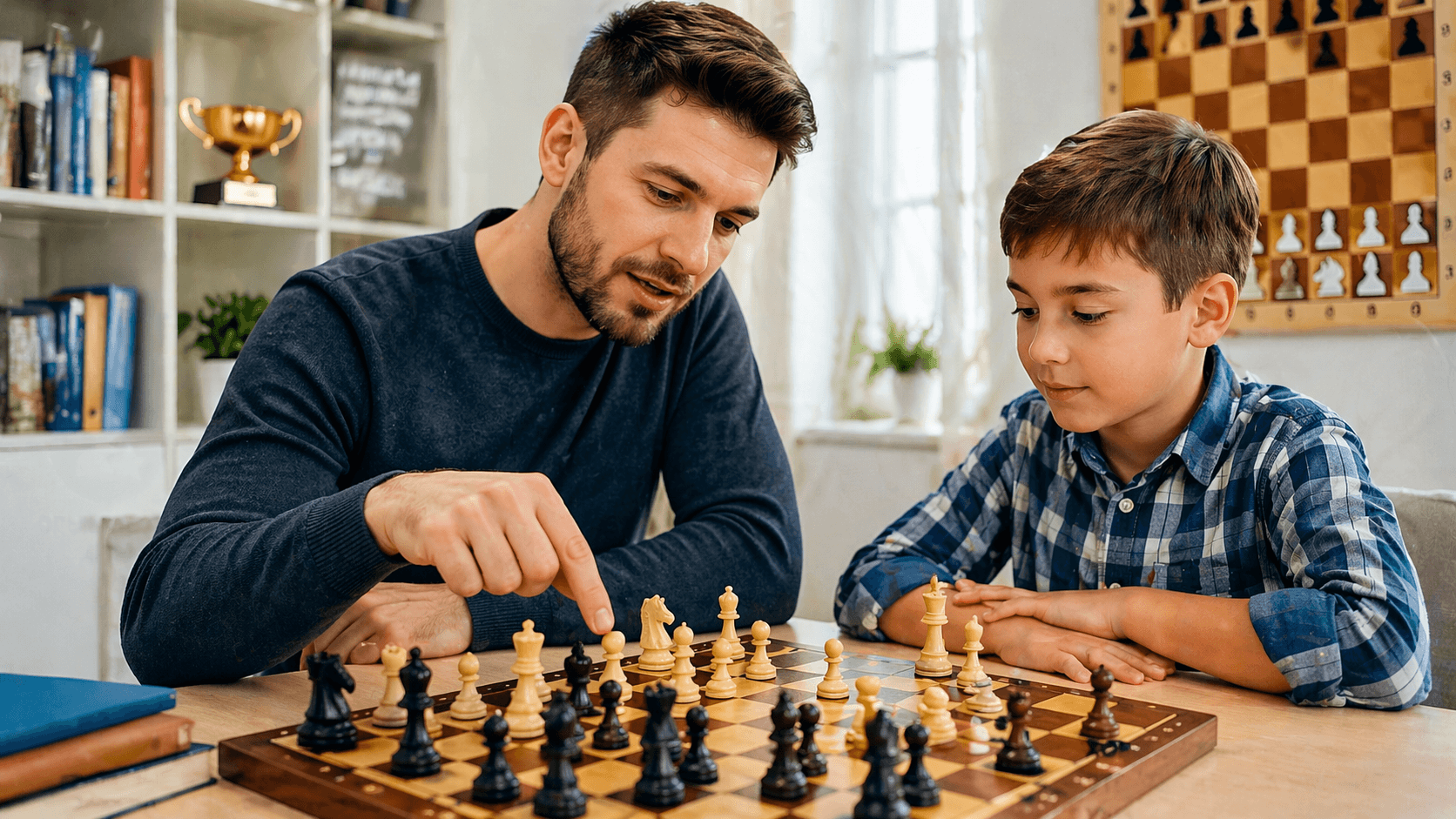
In short: before you pay for an online chess school, make sure your child is actually interested. Private lessons with a coach cost $40–100 an hour, and reaching a basic level takes 30–60 lessons. A sensible first step is an affordable interactive course: it will show whether chess captures your child’s interest and give the same foundation for about the price of a single private lesson.
There are dozens of online chess schools, from projects run by grandmasters to large edtech platforms. Prices differ several times over, and quality differs even more. Here’s how to find your way and avoid overpaying.
What kinds of chess lessons are there
Before choosing a specific school, understand the difference between the formats: each has its own price and logic.
Private lessons with a coach
A personal coach adapts to your child. The most effective format, but also the most expensive. It makes sense once your child is hooked and starting to play in tournaments.
Online group lessons
Several kids with one coach. Cheaper than private lessons, and there’s an element of competition. The downside: less attention for each child.
Interactive course (self-paced learning)
An interactive program that explains the rules and checks exercises automatically. Your child practices independently, at their own pace. The most affordable format, for example the Chess from Scratch course. Ideal for getting started and checking your child’s interest.
Where to find chess lessons online
Prices change, so check them on each school’s website.
Large kids’ chess platforms
Sites like ChessKid, the children’s platform from Chess.com, combine lessons, puzzles and games with other kids in one place. Their strength is a large community and safe play against peers. They suit children who already know the rules and want to play.
Coach directories and tutor marketplaces
Chess.com and Lichess have directories of coaches, and general marketplaces such as Wyzant list chess tutors too. You choose a coach by rating, experience and reviews, and each coach sets their own price. A good option once you know what level of coach your child needs.
Chess clubs and academies
Specialized chess schools with qualified coaches, many of which also teach online. They often offer a free trial lesson. Group lessons are cheaper, private ones more expensive. The plus: a deep focus on chess.
Comparing the formats on the key points:
| Format | Price | Coach involvement | Child’s independence |
| Private lessons | High | Maximum | Low |
| Group lessons | Medium | Medium | Medium |
| Interactive course | Low | Automatic | High |
Each format has its strengths. Private lessons are irreplaceable for tournament preparation but excessive for learning the rules. An interactive course, on the other hand, is ideal for getting started but won’t replace a live coach on the way to competitive play.
What chess lessons really cost
The price of one lesson is a misleading guide. Count the cost of the result instead: how many lessons it will take to reach the goal. To learn the basics, a child has to go through every topic: the board, the pieces and setup, the rook, the bishop, the queen, the knight, the pawn, the king, check, checkmate, castling and how a game ends. That takes roughly 30–60 lessons with a coach.
Let’s calculate the cost of the basics:
| Format | Price per lesson | 30–60 lessons |
| Private coach | $40–100 | $1,200–6,000 |
| Online group | $20–40 | $600–2,400 |
| Chess from Scratch course | — | $44.50, one-time payment |
Prices: Chicago Chess Center, 2026.
An interactive course gives the same foundation as 30–60 lessons at a school, for about the price of a single private lesson. A school still makes sense; what changes is the moment it’s worth paying for. First the basics, then a coach.
Where it makes sense to start
The most common mistake parents make is buying an expensive package of lessons with a coach right away, without knowing whether chess will capture their child’s interest at all. Three lessons in, it turns out the child isn’t interested, and the money is already spent.
An order that protects your budget:
- Check interest with an interactive course. Your child learns the rules independently, and you see whether they enjoy it. The first stages are free.
- If your child is hooked, add a coach. Now lessons at a school make sense: the foundation is there, and the coach works on the game, not on how the knight moves.
- For competitive play, private lessons. Once your child starts playing in tournaments, they need a personal coach.
The Chess from Scratch course is built exactly for that first step: 12 fully voiced stages, 915 exercises, 12 characters from legends around the world and 87 animated achievements. Your child doesn’t read a textbook: they play right in the lesson, and every move is explained out loud. Try the first stage for free.
If you’d like to prepare for lessons in advance, these guides will help: how to teach a child chess and chess rules explained simply.
What if your child can already play
If your child knows the rules and basic moves, they don’t need a course from scratch. They need to develop tactical vision: the ability to spot combinations, traps and winning moves.
For this, the interactive book “250 Chess Traps and Combinations” works well. It isn’t a textbook with diagrams but a live board: your child goes through real traps, sees the variations in color and trains tactics. The first 15 traps are free.
This format works well alongside lessons with a coach: strategy in class, tactics at home on hundreds of positions.
7 things to look for in an online chess school
- A trial lesson. A good school lets you try for free. Don’t buy a package blind.
- Coach qualifications. The coach’s title or rating, and experience working with children.
- A format that fits the age. A 5-year-old needs game-based methods, not lectures.
- Transparent pricing. The real cost of regular lessons, not an advertised “entry price”.
- A convenient platform. An interactive board your child understands, one that works on a tablet.
- A flexible schedule. The option to reschedule lessons.
- Feedback for parents. Reports on your child’s progress.
More on choosing a specific coach is in the article “How to Choose a Chess Coach for Your Child”.
Conclusion
There are many online chess schools, and some of them are strong, from grandmasters’ projects to large edtech platforms. But choosing a school is the second step. The first is finding out whether chess will capture your child’s interest.
Start with an affordable interactive course. If your child’s eyes light up, move on to a coach with confidence. That way you won’t waste hundreds or thousands of dollars, and your child gets a chance to fall in love with the game at their own pace.
Frequently asked questions
Which online chess school is best for a child?
There’s no single best one for everyone: it depends on your child’s level and goals. For kids who already play, coaches and chess academies are strong options. For starting from scratch, an affordable interactive course is the smarter choice, with a school added later.
How much do chess lessons for kids cost?
A private lesson costs $40–100, a group lesson $20–40, according to the Chicago Chess Center. Reaching a basic level takes 30–60 lessons, which means $600 to $6,000. An interactive course gives the same foundation for $44.50.
Can a child learn chess without a school?
The basics, yes. The Chess from Scratch course explains all the rules out loud and checks exercises automatically. A school and a coach are needed at the competitive level.
At what age should a child start at a chess school?
Many schools take children from 6–7. From 4–5, it’s better to start at home with an interactive course. More on this in the article “At What Age Should a Child Start Chess”.
What should we choose if our child can already play?
Not a course from scratch but tactics training. The interactive book “250 Chess Traps and Combinations” develops chess vision on real positions. It works well alongside lessons with a coach.
Before choosing a school, check your child’s interest
The Chess from Scratch course: 12 fully voiced stages and 915 exercises. The same foundation as 30–60 lessons at a school, for a one-time $44.50.