How to Teach a Child Chess: Chess Class, Private Tutor or a Course at Home
In short: there are three ways to teach a child chess: a chess class (a chess school or club), a private tutor, or an interactive course at home. You don’t have to start with a class. It’s often smarter to first find out whether your child is interested and build the basics at home: it costs less, and your child arrives at a class already prepared. Five practicing chess coaches reviewed the Chess from Scratch course and confirmed that this format works as a first step.
A parent who decides to teach their child chess usually thinks: we need to find a class or a tutor. It seems there’s no way around lessons with a specialist. But that isn’t the only option, and not always the best first step. Let’s look at all three honestly, with prices, pros and cons, and the opinions of practicing coaches.
What “teaching a child chess” really means
When parents look for ways to teach their child chess, they usually mean the first steps, and that’s the right approach. Real chess is a lifelong study: even grandmasters keep improving. No one becomes a master in a dozen lessons, and that isn’t the goal of the start.
Any big skill rests on a foundation. Advanced math starts with arithmetic, and chess starts with how the pieces move and what check and checkmate are. How well the basics are laid determines everything that comes after.
So teaching chess “from scratch” means giving the right foundation: your child should know the rules with confidence, understand the logic of the game and want to keep playing. That’s exactly what the Chess from Scratch course is built for. It takes a child to the level where real play begins.
What practicing coaches say about the course
Before comparing the options, let’s look at an independent assessment. We asked working coaches and masters to review the Chess from Scratch course and give honest feedback, both strengths and criticism. Their opinions address the main question: does this format work as a first step in chess?
Dmitry Aleksandrovsky
FIDE Master, rating 2300+, graduate of Anatoly Karpov’s chess school
“The course does a brilliant job of teaching chess from scratch, up to the level where a child knows all the rules and how every piece moves, flawlessly. The structure looks completely right: theory is followed immediately by practice, so everything sinks in right away.”
Sergey Averchenko
FIDE Master, FIDE Arbiter, national-category arbiter, coaching since 1992
“The material is structured competently and logically, and the format is ideal. The exercises match the level and format of the material. Interactive learning is the future. As a first introduction to the game, the course is quite good.”
The coaches also pointed out what could be improved, for example the audio and the length of some sections. We take these comments into account as we develop the course. But on the main point they agreed: the “explanation plus immediate practice” approach works, and as a first step into chess the course does its job.
Three ways to teach a child chess
Chess class (school or club)
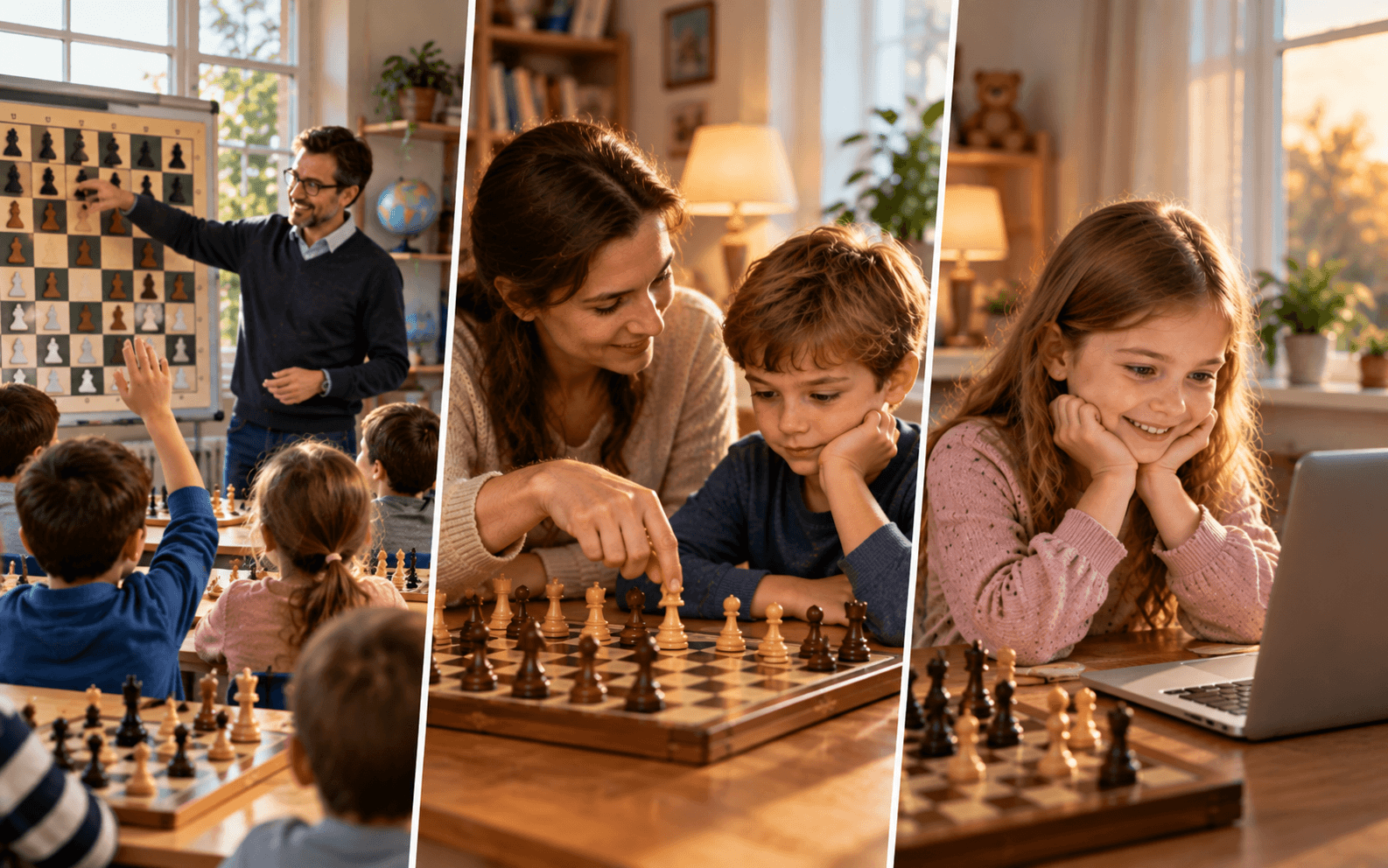
Group lessons with a coach, usually 6–10 kids. Pros: social contact, a competitive spirit, tournaments and the discipline of a schedule. Cons: everyone moves at the same pace (whoever didn’t get it falls behind), there’s little individual attention, and you’re tied to a place and time. Price: in Chicago, for example, group classes cost $20–40 per session, according to the Chicago Chess Center.
Private tutor
One-on-one lessons. Maximum attention and a program built around your child. But it’s also the most expensive option: $40–100 an hour, according to the same Chicago Chess Center guide. Learning the basics from scratch takes 30–60 lessons, which comes to $1,200–6,000.
Interactive course at home
An interactive program where your child learns independently: a short voiced explanation, then exercises. Your child goes at their own pace, and the whole course costs $44.50. For example, Chess from Scratch has 12 stages and 915 exercises. The downside: there’s no live opponent and none of the social side a class provides.
Prices vary by city and coach, so check with a specific school or tutor. A detailed comparison of the formats is in the article How to Choose an Online Chess School.
What a chess class gives a child
A chess class for kids is more than lessons. Its main value is something no book or home course can give: a live environment. Your child plays real opponents at their own level, takes part in tournaments, learns to lose and bounce back, and finds a group of peers who share the passion.
A group setting suits children who are motivated by competition and company: many kids enjoy practicing with others more than alone. Here chess becomes not just an activity but a hobby. The coach sees your child play in person, goes over mistakes and sets long-term goals, such as rating milestones and tournament results.
A class is especially useful once your child has learned the basics and wants to move on: to grow, compete and develop. When choosing one, look at the coach’s qualifications, the group size, whether there’s tournament practice, and whether you can try a class first. The criteria are covered in detail in the article How to Choose an Online Chess School.
Why a class isn’t necessarily the first step
Classes and tutors offer a lot, but starting with them isn’t always the smartest move. Let’s look at two common situations.
Parents are still checking whether their child is interested. Signing up for a class, paying for a month and driving to lessons take noticeable time and money just to find out whether chess will catch on. A home course lets you start with a smaller investment: if it doesn’t work out, you’ve lost almost nothing, and if your child gets hooked, you move on to a class with confidence.
A class or tutor is already planned. Then a foundation gives your child a head start. In a group lesson where the coach explains the basics to everyone at the same pace, a prepared child has it easier: they already know how the pieces move and the rules, so they don’t spend energy on the basics and can join in the games and analysis right away. And the coach has something to work with.
At what age to start
On average, around age 5 is a good time to start learning chess, but every child is different: a lot depends on attention span and readiness. Practitioners agree on one point: younger children are more comfortable practicing together with a parent, and a child can usually manage fully on their own closer to age 6–7.
This fits the course format well: a parent goes through the first stages together with the child, and after that the program takes the lead. More on age and signs of readiness is in the article “At What Age Should a Child Start Chess”.
What your child brings to a class after the course
After finishing the course, your child is ready for lessons at a school or with a tutor. They already:
- know all the rules and move every piece with confidence
- understand what check and checkmate are
- can castle
- know the value of the pieces and trade them to their advantage
- solve simple combinations and checkmate puzzles
- can play a full game
With this foundation, the coach works on your child’s game instead of spending the first lessons explaining how the knight moves. That’s exactly the foundation the Chess from Scratch course provides.
Conclusion
A class, a tutor and a home course aren’t competitors; they’re different steps. Classes and tutors provide depth, live play, tournaments and community. But you don’t have to start with them: your child can learn the basics at home, and you’ll find out along the way whether they’re interested.
A sensible order is an interactive course at home first. It will show whether chess captures your child’s interest and give them a foundation for little money. Then, once the interest is confirmed, a class or tutor for live play, tournaments and growth. Practicing coaches confirm that as a first step this format does its job.
Frequently asked questions
Do I have to send my child to a chess school?
Not at the very start. The basics (rules, how the pieces move, check and checkmate) can be learned at home with an interactive course. A school shows its value later: it offers games against live opponents, tournaments and in-depth work with a coach, things you can’t get at home.
Can I teach my child chess if I don’t play myself?
Yes. The Chess from Scratch course explains everything out loud, to both the child and the parent. You don’t need to know chess: the program leads the way.
What should we start with: a school, a tutor or a course?
A home course is a convenient first step: it’s inexpensive, helps you check your child’s interest and gives a foundation. Once your child is hooked, add a school or tutor for live play, tournaments and further growth. It’s not “either/or” but a sequence.
Won’t the school say my child already knows everything and will be bored?
Quite the opposite. A prepared child moves on faster to the interesting part: playing, tactics and tournaments.
Start by checking your child’s interest
The first two stages of the course are free, no credit card needed. Try them and see how well the format suits your child before you pay for a school or a tutor. A limited-time offer on the full course is available on the course page.